Oh Fudge!
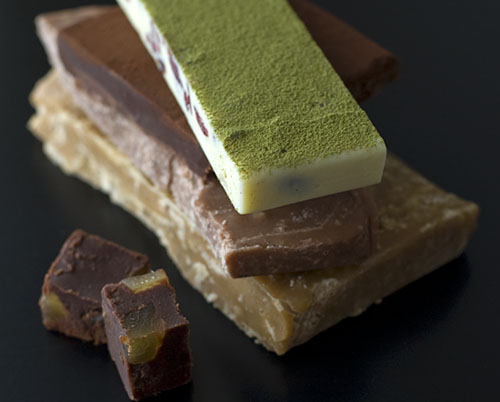
(Left : Chocolate and ginger fudge. Top to bottom : White chocolate, green tea and cranberry fudge, Peanut butter fudge, Trish Deseine’s Chocolate fudge, Alain Ducasse’s Brown sugar fudge.)
If your local supermarket has recently been suffering from a severe lack of caster sugar, chances are, you live in my neighbourhood. Up until last week, fudge and I had been existing on this planet, on separate orbits. Even now, I feel like we will forever remain on speaking, but separate, terms. But it was a swift sweet romance and breakup that had to happen : my kitchen, it overfloweth with fudge.
This obsessive affair all started with Lorraine and her quest to make the perfect creme brulee fudge. A few perfectly harmless emails were thrown back and forth, concerning the subject and I confessed at that point that I had never really paid much notice to fudge. Fudge? Isn’t that merely a clash between condensed milk and chocolate, coupled with a few extra expensive visits to the dentist?
Her enthusiasm however leaked into my innocent fudge-free world, and soon I was reaching for every single possible cookbook I had that might contain information on fudge.
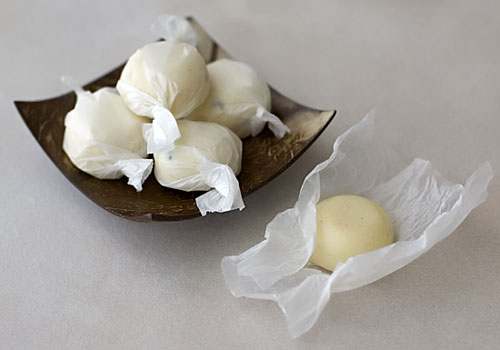
(White chocolate, lavender and coconut fudge)
In theory, fudge is a crystallised sugar confection, produced using a somewhat similar method to fondant, with the addition of flavours, fat and dairy products (butter, cream, milk). Who would have guessed that such a simple handful of ingredients accompanied by a deceptively easy set of instructions, could yield so many different results? It is with some relief that I read Greweling’s statement that, “in spite of the fact that these candies are often made by nonprofessionals, achieving the proper crystal size and moisture content, and therefore a smooth creamy texture, is not a simple feat”. Indeed, Greweling is quite detailed and comprehensive on the topic and has a few recipes I would love to try, as soon as I get my hands on some invert sugar. Wybauw had similar points to note regarding fudge, but the few recipes I tried of his didn’t work well enough for me to be convinced that I had been successful.
Seven batches later, and I have finally come across a recipe that I’m fairly happy with. I’m still experimenting with it, so a final recipe shall be forthcoming in a future post.
In the meantime, for those wanting to make an easy, quickfix, crowd-pleasing batch of fudge, you can’t go wrong with the recipe below. This is not by any means a traditional fudge, but whatever you want to call it, it is incredibly delicious and deserves at least two seconds in the spotlight. The lemon juice and salt cleverly elevate this above the many pedestrian fudge recipes of its ilk. In fact, the next time I make this, I would be tempted to add even more lemon/lime juice, to further cut the sweetness of the white chocolate.
White Chocolate Fudge :
(based on a recipe in The Cook’s Guide to Chocolate by Christine McFadden and Christine France)
600g good quality white chocolate, chopped
375g sweetened condensed milk
1 teaspoon vanilla extract
1 1/2 teaspoons lemon juice [or lime juice]
pinch of salt
(optional : 175g extra ingredient of choice – eg. pistachios, cranberries, dessicated coconut etc)
Grease and line a baking tin with greaseproof paper. [The choice of tin is up to you, depending on how thick or thin you want your fudge to be (for presentation purposes). The Cook’s Guide recommends an 8″ square tin.]
In a saucepan over low heat, melt the white chocolate and condensed milk until smooth, stirring frequently [use a heatproof spatula, to make sure no bits get stuck on the bottom of the pan]. Remove from the heat and stir in the vanilla extract, lemon juice and salt. Stir in any additional ingredients. Spread the mixture in the prepared tin. Chill for 2 – 4 hours until set.
Tags: fudge, matcha, white chocolate