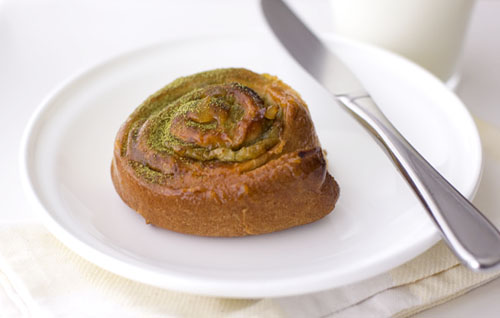
Green tea custard scrolls

What is it they say about April showers that seems to apply to Sydney at the moment? We are awash with neverending rain and gloomy skies that make me want to stay rugged up all day, nibbling pastries and sipping tea.

April is usually one of my favourite times of the year, what with the many hot cross buns I have already put away (straight onto my hips). At school, April was the time we exchanged Easter eggs, made plans to meet up during the holidays, and talked endlessly about the showbags we were going to get at the Royal Easter Show. This year is made even more exciting by the impending visit of my sister and her family from New Zealand. It’s been awhile since I last saw my little nieces. We are planning to take them (and B) to their first ever Show, and I expect I’ll be sharing pictures of our day spent there, in the near future.

In the meantime, this weather has put me in the mood for a little baking. These brioche scrolls were inspired by a delicious matcha and adzuki bean danish we had at Sadaharu Aoki’s patisserie when we were last in Tokyo. I spread a very generous layer of green tea custard on the brioche dough, scattered some chopped candied ginger and white chocolate on top, then rolled up the dough and portioned it into 12 pieces. These scrolls are incredibly good, straight from the oven, when the custard is still warm and slightly oozy. I had two just while standing there, supervising them as they cooled the rack.
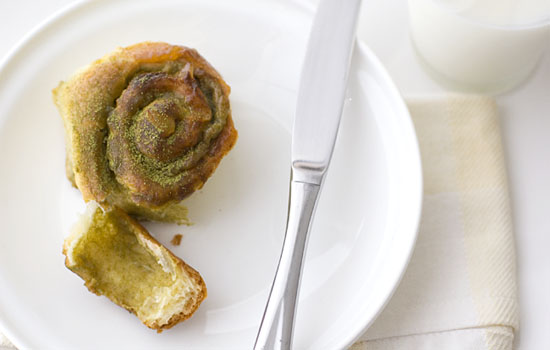
Raquel of Growing Up Green recently passed on an award to me. As thanks, I am dedicating these green tea custard scrolls to her.

Green Tea Custard Scrolls :
(makes 12)

Brioche :
(based on a recipe in Gourmet Traveller Sept 2006)
80ml milk
5g dried yeast
300g plain flour
2 tablespoons caster sugar
1 egg, at room temperature
100g unsalted butter, softened

250 – 300g green tea custard (recipe below)
optional extras : sweetened adzuki beans, chopped candied ginger or white chocolate buttons etc

Warm the milk in a saucepan (to about blood temperature), add the yeast and whisk until yeast dissolves. Stir in 30g flour and stand for 10 minutes or until foamy.

Combine remaining flour, sugar and 1/2 teaspoons sea salt in an electric mixer fitted with a dough hook and mix for 2 minutes on lowest setting. Pour in yeast mixture and egg, mixing until it just comes together [Note: Add a splash more milk if the dough is looking too dry]. Increase speed to medium, add butter a little at a time, then increase speed to high and mix for 5 minutes or until smooth. Transfer dough to a lightly oiled bowl, turn to coat, cover with plastic wrap and stand in a warm place for 1 hour.

Turn brioche dough onto a lightly floured surface, knock back, then knead lightly until smooth. Roll out a 20cm x 55cm rectangle, then, with the long side facing you, spread evenly with green tea custard, leaving a 2cm border on the far long side. Scatter any optional extras you want on top of the custard. Roll into a cylinder, then cut into 12 even pieces and place, cut-side down, closely on a baking paper-lined oven tray and stand for 10 minutes or until risen. Bake at 180’C for 30 minutes or until light golden.

While still warm, brush lightly with a little apricot glaze. When cooled, dust with more green tea powder or icing sugar.

Green tea custard :
(based on a recipe from Pastry : Savory and Sweet by Michel Roux)
[Note: This recipe yields more custard than you need for the scrolls. You can cut the recipe by half, or make the full recipe and use the custard in other ways – as a filling for crepes, for example]
6 yolks
125g sugar
20g plain flour
20g custard powder
500ml milk
1 teaspoon vanilla extract
2 teaspoons green tea (maccha/matcha) powder (or more, if you like it stronger)

In an electric mixer, whisk yolks and a third of the sugar until very thick and pale. Whisk in flour, custard powder and green tea powder.

Heat the milk with the remaining sugar and vanilla. When it boils, pour it onto the egg yolk mixture. Mix well, then return to the stove. Bring to boil, stirring continuously with a whisk. Let it simmer for two minutes, stirring, then strain the custard into a bowl. Place some cling film over the surface of the custard to prevent a skin from forming. Allow to cool completely before using.

(The best way to rapidly chill down the custard is by placing the bowl in an iced water bath. This custard can be made ahead, and kept in the fridge for several days before using.)
Comments (30)

Tags: , ,

Recently, lamingtonrons

Recently watched : Låt den rätte komma in

Recently wondered : If Cloudy, with a chance of Meatballs could quite possibly be the next ultimate foodie movie.

Recently heard : Röyksopp

Recently prayed to the food gods at : Spice Temple (recommended : Steamed eggplant with three flavours; Leatherjacket drowned in dried chilli and Sichuan peppercorns)

Recently baked : Lamington-rons!

Why?

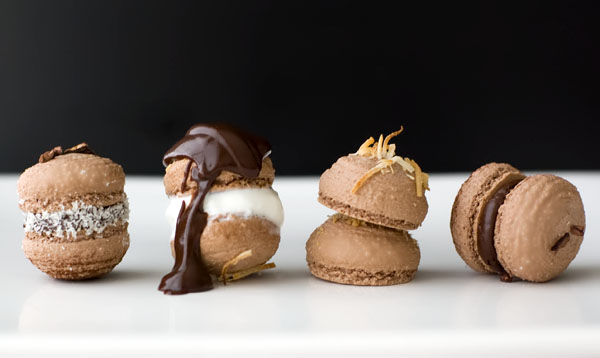
Well, just when you think you have sufficiently scratched that itch, along comes another temptation to ponder the benefits of one macaron method over another. This latest temptation comes in the form of Julia’s lovely blog. My favoured standard macaron method isn’t too dissimilar to the one Julia was taught at a macaron class she took in Melbourne. It’s quick, and I always get results I’m very happy with, but I am definitely warming to the Italian meringue method which she also uses to great effect.

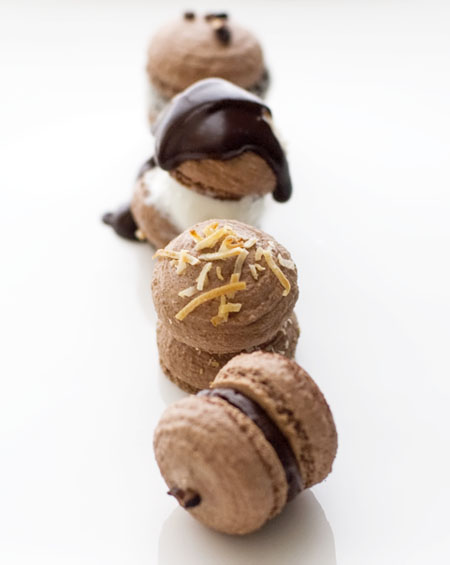
For these lamington inspired macarons, I chose to use David Everitt-Matthias’ recipe for chicory macarons from his new book (and my latest cookbook infatuation), substituting chicory as a flavour, with cocoa powder. What I found with the Italian meringue method was that the resulting raw mixture was incredibly stable. Where it’s not unusual to get a slightly less than 100% yield with my normal method, with this batch, I managed a full yield. Well, maybe 80%, because I ate a few. 😛

In the future, I hope to explore this method a little further. Next time though, I will stick to my usual step of sifting the almond meal and icing sugar before using it. I like sifting the dry ingredients to get rid of any larger bits of nut meal which would cause the macaron shell to look less smooth. They were a little bumpy in appearance on this occasion, but certainly no less tasty.

Chicory Macarons :
(makes 18; from Dessert by David Everitt-Matthias)

200g caster sugar
50 ml water
140g egg whites (4 – 5 whites)
200g icing sugar
200g ground almonds
30ml chicory essence

Put the caster sugar and water in a heavy-based pan and heat gently, stirring to dissolve the sugar. Raise the heat, bring to the boil and cook without stirring until the syrup reaches 120’C on a sugar thermometer. When it reaches approximately 110’C, whisk the egg whites to soft peaks in a freestanding electric mixer. When the syrup reaches the correct temperature, slowly pour it onto to the whites, whisking constantly. Carry on whisking until the mixture is thick and very stiff.

Mix the icing sugar and ground almonds together and add slowly to the egg whites, gently folding them in. Finally fold in the chicory essence. Place in a piping bag and pipe on to a tray lined with baking parchment, making rounds approximately 3cm in diameter. Allow to dry for about 30 minutes. This is important, as it allows a skin to form before you bake them. Place in an oven preheated to 180’C and bake for 8 – 12 minutes [Note : mine were ready at the 9 minute mark]. Ideally the vent of the oven should be open, but you could just prop the door open slightly [Note : I don’t really think this is necessary, but I did very slightly open the door of the oven for a second or two, half way through the baking process]. The macaroons should be firm to the touch and crisp when cool. Remove from the oven, leave to cool, and then remove from the baking parchment.

Chicory Ganache :

70ml double cream
10ml chicory essence [I omitted this]
100g bitter chocolate (71% cocoa solids), chopped
30g unsalted butter

Put the double cream and chicory essence in a small saucepan and bring to the boil. Remove from the heat and put to one side for 2 minutes. Put the chopped chocolate in a bowl and pour on the hot cream. Stir until the chocolate has melted [Note : If you have trouble getting the chocolate to melt before the cream cools down, do this over a bain marie, but be careful not to overheat the mixture], then add the butter and stir until amalgamated. Leave to cool completely, then whisk until smooth. Sandwich the macaroons together with the ganache.

Comments (29)

Tags: , , ,

Daring Bakers Challenge : Lasagne

The March 2009 challenge is hosted by Mary of Beans and Caviar, Melinda of Melbourne Larder and Enza of Io Da Grande. They have chosen Lasagne of Emilia-Romagna from The Splendid Table by Lynne Rossetto Kasper as the challenge.

I had my first taste of lasagne when I was about ten. I still remember it, not for it’s culinary excellence, but because I was obsessed with Garfield at the time, and lasagne was Garfield’s favourite food. I also recall the moment clearly because I was in awe at my friend’s glamorous mother who, from her glamorous kitchen, pulled out this glass casserole dish of mysterious lasagne.

I have eaten a few more lasagnes since then. Mom would make us her deliciously inauthentic versions on occasion – my favourite bit was always the crispy golden crust on top. Somehow though, lasagne never equated to me as something I craved on a regular basis. In fact, I can’t even remember the last time I ate, let alone baked, a lasagne.

Until, that is, this month’s DB challenge. The choice of lasagne took me by surprise, but I welcomed it with open, floury arms, relishing the idea of making a lasagne entirely from scratch. Pasta and all! Foregoing the purchase of a pasta machine, I decided to hand roll my pasta, which I knew would be a challenge unto itself, on account of my weedy arms. So I strugged, and broke into a sweat, and struggled some more. All this, whilst trying to channel my two very un-Italian/extremely-Chinese grandmothers; one of whom made noodles by hand on a daily basis for her large family, and the other still has the patience to make thousands of miniature deep fried spring rolls, each one thinner than a pencil. The end result, after much sponging of the brow and discrete swearing under the breath, was well worth the effort, with B giving the dish a big thumbs up.

Of the three recipes provided for this challenge, I completed two : the spinach pasta and the bechamel sauce. Instead of the ragu, I went vegetarian and opted to make a basic tomato sauce. Since the recipes are quite long, I’m only including the spinach pasta recipe in this post, which I would unhesitatingly make again.


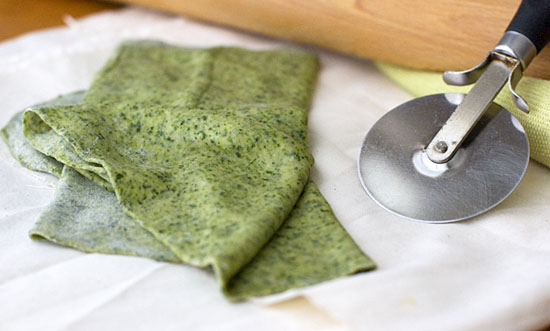
(Pictured : Spinach pasta sheet, rolling pin, cutter and extra cloth for sponging brow)

Spinach Egg Pasta (Pasta Verde) :
(Makes enough for 6 to 8 first course servings or 4 to 6 main course servings, equivalent to 450g dried boxed pasta; based on the recipe for the lasagne of Emilia-Romagna)

2 jumbo eggs (60g or more)
300g fresh spinach, rinsed dry, and finely chopped; or 170g frozen chopped spinach, defrosted and squeezed dry
400g all purpose unbleached (plain) flour [I used Italian OO flour]

Mixing the dough:
Mound the flour in the center of your work surface and make a well in the middle. Add the eggs and spinach. Use a wooden spoon to beat together the eggs and spinach. Then gradually start incorporating shallow scrapings of flour from the sides of the well into the liquid. As you work more and more flour into the liquid, the well’s sides may collapse. Use a pastry scraper to keep the liquids from running off and to incorporate the last bits of flour into the dough. Don’t worry if it looks like a hopelessly rough and messy lump.

Kneading:
With the aid of the scraper to scoop up unruly pieces, start kneading the dough. Once it becomes a cohesive mass, use the scraper to remove any bits of hard flour on the work surface – these will make the dough lumpy. Knead the dough for about 3 minutes. Its consistency should be elastic and a little sticky. If it is too sticky to move easily, knead in a few more tablespoons of flour. Continue kneading about 10 minutes, or until the dough has become satiny, smooth, and very elastic. It will feel alive under your hands. Do not shortcut this step. Wrap the dough in plastic wrap, and let it relax at room temperature 30 minutes to 3 hours.

Stretching and Thinning:
With a regular-length rolling pin, roll out a quarter of the dough at a time and keep the rest of the dough wrapped. Lightly sprinkle a large work surface with flour. The idea is to stretch the dough rather than press down and push it. Shape it into a ball and begin rolling out to form a circle, frequently turning the disc of dough a quarter turn. As it thins outs, start rolling the disc back on the pin a quarter of the way toward the center and stretching it gently sideways by running the palms of your hands over the rolled-up dough from the center of the pin outward. Unroll, turn the disc a quarter turn, and repeat. Do twice more.

Stretch and even out the center of the disc by rolling the dough a quarter of the way back on the pin. Then gently push the rolling pin away from you with one hand while holding the sheet in place on the work surface with the other hand. Repeat three more times, turning the dough a quarter turn each time.

Repeat the two processes as the disc becomes larger and thinner. The goal is a sheet of even thickness. For lasagne, the sheet should be so thin that you can clearly see your hand through it and see colours. Cut into rectangles about 10 x 20 cm. Note: Enza says that transparency is a crucial element of lasagne pasta and the dough should be rolled as thinly as possible. She says this is why her housekeeper has such strong arms!

Dry the pasta at room temperature and store in a sealed container or bag.

Comments (53)

Tags: ,

« Previous Page · Next Page »