Daring Bakers Challenge : Puddings

DaringBakers-Pudding

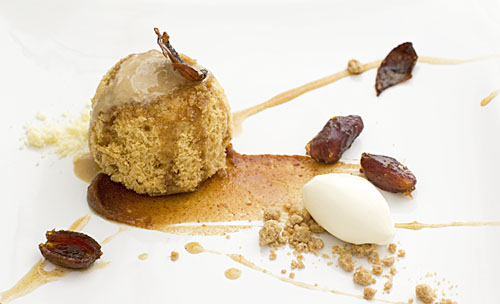
(Manuka honey pudding with coffee, chestnut and dates)

The April 2010 Daring Bakers’ challenge was hosted by Esther of The Lilac Kitchen. She challenged everyone to make a traditional British pudding using, if possible, a very traditional British ingredient: suet.

Pudding purists may want to avert their eyes now. As I was very pressed for time this month, a few shortcuts were taken in order to make the deadline for the challenge. I opted for one of the recipes provided that called for butter rather than suet, and instead of steaming the pudding (which would have taken hours), the mixture was (gasp)microwaved(gasp). It literally took one minute to cook the pudding, and rather pleasingly, it turned out gloriously fluffy and very very tasty.

The pudding was flavoured with Manuka honey – a decision brought about mainly by my wish to utilise that rather lonely jar of New Zealand’s finest honey sitting in the cupboard. The combination of the honey with a hint of vanilla and spice in the pudding, brought to mind classic sticky date pudding, hence the date and coffee puree, as well as a scattering of chestnut crumble (to complete that Autumnal touch), some poached dates and crispy date skins.

While this hasty pudding ended up being pretty tasty, I still kind of wish there had been time to attempt a traditional Sussex pond pudding or a steak and kidney pie – two things that just so happen to be on the list of things I want to try baking. Perhaps it will finally happen, when this hectic daze that I’m in calms down a little….

YogurtPudding-Moro

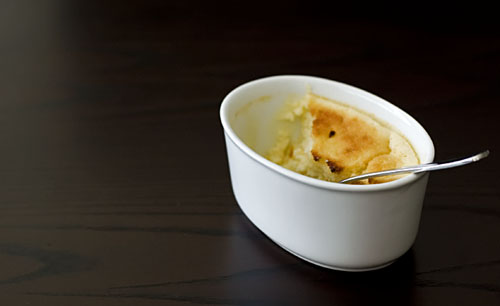
(Yogurt cake)

Meanwhile here’s another pudding I made recently when we fancied a quick and fairly healthy dessert. This wonderful Lebanese recipe is from the Moro cookbook and is incredibly easy to make. It contains only a very small amount of flour, and so can be adapted to be gluten-free as well. The pudding was so light, clean and citrussy that it practically needed no accompaniment, but if need be, I can imagine it pairing well with stewed rhubarb or berries and stonefruit.

Yogurt cake with pistachios :
(from Moro The Cookbook by Sam and Sam Clark)

3 large organic or free-range eggs, separated
70g caster sugar
2 vanilla pods, split in half lengthways
350g yogurt (home made yogurt, or Greek yogurt thinned with a little milk)
finely grated zest of 1 lemon and 1/2 orange
juice of 1 lemon
20g plain flour
30g shelled unsalted pistachio nuts, roughly chopped [I omitted these as I didn't have any at the time]

Preheat the oven to 180′C and put a bain-marie of water in to warm on the middle shelf. Have ready a 25cm round or square baking dish or cake tin with a solid bottom, preferably stainless-steel, or lined with greaseproof paper.

In a bowl beat the egg yolks with three-quarters of the sugar until thick and pale. Scrape out the seeds from the vanilla pod and mix into the egg-sugar mixture. Add the yogurt, lemon and orange zest, lemon juice and the flour and mix well. In a separate bowl whisk up the egg whites with the remaining sugar until soft peaks form. Gently and evenly, fold the whites into the yogurt mixture. Pour the mixture into the baking tin. Place the tin in the bain-marie, making sure that the boiling water comes halfway up the tin, and cook for about 20 minutes. Then add the chopped pistachios, sprinkling them gently on top, and continue cooking for a further 20 minutes or until the top is light brown in colour. The correct consistency of the cake should be a light sponge on top with a wet custard below. Serve with yogurt.

Comments (59)

Tags: , , , , , , ,

Daring Bakers Challenge : Orange Tian

DaringBakers-OrangeTian

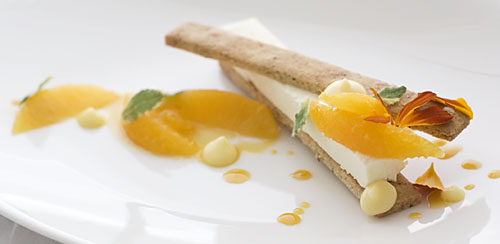
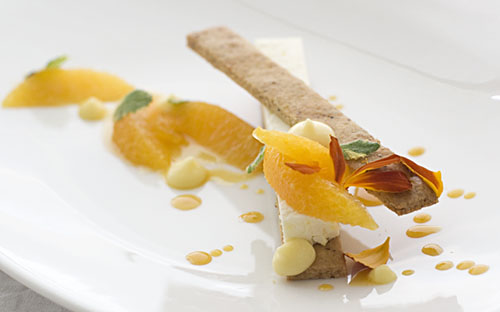
(Orange ‘Tian’ – hazelnut sable, lemon curd, apple mint)

The 2010 March Daring Baker’s challenge was hosted by Jennifer of Chocolate Shavings. She chose Orange Tian as the challenge for this month, a dessert based on a recipe from Alain Ducasse’s Cooking School in Paris.

You know what they say : sometimes the simplest things are the best, and it doesn’t get any simpler than oranges, whipped cream and pastry. On paper, this sounds like an unexciting, rather basic dessert. Having now tasted my assembled version of the orange tian, I can certainly see its appeal. The burst of flavour from the juicy orange segments draped in slightly bitter orange caramel, offset the sweet richness of the whipped cream (folded through with homemade marmalade) and pastry. The whole is understated, but well balanced. It’s the kind of tricky, subtle balance that many of us bakers strive to achieve but don’t always succeed in accomplishing. It’s like knowing how many swear words to insert into Al Swearengen’s dialogue without making him sound too ridiculous. Or how many ruffles you can fit onto a dress before you get panned on Go Fug Yourself.

DaringBakers-OrangeTian3

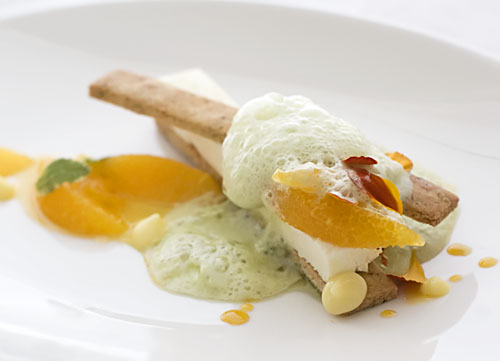
I must admit, I like adding ruffles to my desserts. I ruffled this dessert up with the addition of lemon curd and little white-green apple mint leaves, which have a flavour I would liken to minty olives (predominantly mint, with a finish that is grassy and very much like extra virgin olive oil). I also ruffled the end result with some green tea froth (as pictured below), but decided in the end that it was one ruffle too many.

My favourite components from the recipe provided were the homemade marmalade and the whipped cream. The whipped cream was stabilised with gelatine and flavoured with a small amount of the marmalade. I altered the recipe slightly to include some yogurt and the end result was quite light and refreshing. The marmalade, my first attempt at making one, was very easy to put together and since I didn’t use much of it in my plated dish, I now have a nice small container of marmalade to use in other things. I’m already considering my breakfast tomorrow, and thinking of a breakfast-inspired dessert.

All in all, an enjoyable little treat (perfect for the current weather too!), with many thanks to Jennifer. If you’d like any of the recipes, you can get them from her blog.

DaringBakers-OrangeTian2

(..with green tea)

Comments (62)

Tags: , , , , , , , ,

Once more, with passion.

PassionfruitCustard

(Passionfruit custard with candied ginger boterkoek)

A few days ago, I was given a bag of passionfruit, freshly picked from a friend’s backyard. Edible gifts like these are my favourite thing to receive. I often ‘pay it forward’ by baking with these gifts which are then given away to other people.

These passionfruit were especially good – large, heavy fruit with shiny skins and a really sweet, sharp aroma that lifted into the air when you cut into one. I’m not a fan of eating passionfruit ‘neat’ – something about it’s acidity does not agree with me unfortunately. Combined with dairy products or baked in cakes and cookies however, it becomes a pleasant, perfumed flavour that I would happily enjoy any day.

I love pairing passionfruit with white chocolate ganache, vanilla ice-cream, pineapple bavarois, coconut pannacotta or even served simply as a passionfruit curd tart (caramelise each individual slice with some icing sugar and a blowtorch, for that extra special touch). Passionfruit also goes well with floral flavours like violet and lavender, citrus fruits such as yuzu, mandarin, lemon and lime, and spices like star anise and tonka bean. Serve with nasturtium petals or borage, if you can source any.

Passionfruit-Sake-Lavender2

(Passionfruit custard with sake and lavender)

With the passionfruit I was given, I decided to make a custard. Something about the silky, soothing nature of custards really appeals to me at the moment. If my life were an ad, there would be bluebirds chirping in the background and butterflies fluttering at the edges of my vision as I savour each spoonful.

Passionfruit-Sake-Lavender3

Granted, this custard is more of a set cream, but it has the texture and lazy flow of a custard, and eats like one, so I’m sticking with the name. This custard is insanely good with ginger boterkoek, or for something a little more fancy, it can also be dressed up with tapioca pearls, sake bubbles and twice-baked lavender shortbread.

Nasturtium

(For those moments where you need a little peace and quiet..)

Passionfruit Custard :

415g pouring cream (35% fat)
50g European-style yogurt
185g skim milk
120g passionfruit juice (strained pulp from approximately 6 large passionfruit)
70g caster sugar
2 1/2 leaves gold-strength gelatine, soaked in iced water until soft and pliable

Warm the cream, yogurt, milk, passionfruit juice and sugar in a pan, stirring until the sugar dissolves. Squeeze the water out of the gelatine, and add it to the cream mixture. Whisk this gently until dissolved, then strain the mixture into a bowl. Allow to cool before pouring it into your desired containers. Allow the custards to chill overnight in the refrigerator before using.

Candied Ginger Boterkoek :
(Boterkoek is a Dutch buttery shortcake. You can alter the flavourings to suit your preferences. This recipe is from Warm Bread and Honey Cake by Gaitri Pagrach-Chandra)

150g caster sugar
250g plain flour
1/4 teaspoon salt
zest of 1/4 lemon
200g butter, softened
1 egg yolk
a little beaten egg, for glazing
100g stem (preserved) ginger, drained and chopped
75g fine dessicated coconut

Optional:
55g blanched whole almonds
55g skinned hazelnuts

Mix the caster sugar, flour, salt and lemon zest together in a large bowl. Add the softened butter and egg yolk and knead until everything is well mixed in. Knead in the ginger and coconut. Shape the dough into a ball and put it in a sealed plastic bag in the refrigerator overnight.

Next day, remove the dough from the refrigerator and leave to come to room temperature.

Preheat the oven to 180′C. Grease a 24 cm/9 inch round tin and dust with flour.

Knead the dough very briefly, then shape it into a large disc and put it in the tin. Use your hand to flatten it as evenly as possible to fit the tin. Brush with beaten egg. If you are using almonds or hazelnuts, press them into the surface. Otherwise, score a plaid pattern onto the surface with a fork.

Bake in the oven for 20 – 25 minutes. Boterkoek should never be hard of crisp, so this should be baked only until just done. It will be soft when it comes out of the oven. Leave to cool until lukewarm in the tin, then carefully turn it out onto a wire rack to cool completely.

Store in an airtight container in a cool place so that the butter doesn’t go rancid. It will keep for at least 1 week but is at its best after 24 hours.

Twice-baked lavender shortbread :
(based on a recipe from Pure Dessert by Alice Medrich)

170g unsalted butter, melted and still warm
5 tablespoons caster sugar
1 teaspoon pure vanilla extract
1/4 teaspoon sea salt
190g plain flour
1 1/4 teaspoons dried lavender buds

Line a 7 x 10 inch pan with baking paper.

In a bowl, combine the melted butter, sugar, vanilla, lavender and salt. Add the flour and mix until just incorporated. Spread the dough evenly in the pan. Let it rest overnight on the kitchen counter (don’t refrigerate).

Preheat the oven to 150′C. Bake the shortbread for 45 mins, then remove the pan from the oven. While the shortbread is still warm, use a pizza cutter or sharp knife to cut the shortbread into the desired shapes. Allow to cool for 10 minutes, then lift the cut pieces onto a baking lined tray, positioning them slightly apart so that they bake evenly. Return the shortbread pieces to the oven for an additional 15 minutes, then remove from the oven and allow to cool completely on a rack.

Comments (50)

Tags: , , , , , ,

« Previous entries Next Page » Next Page »