BBD #7 : Flatbreads

chapati2.jpg

Petra of Chili und Ciabatta is hosting BBD #7 and joy of joys, she has picked flatbreads, as the theme. Here’s my excuse, and an impetus, to have a go at making Chapati.

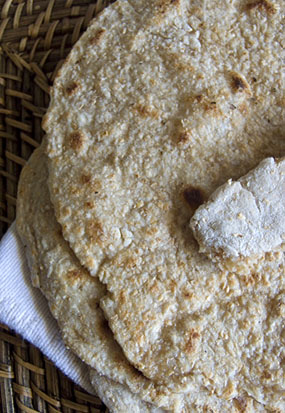
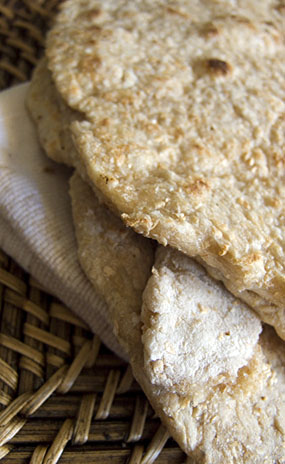
Flatbread doesn’t get quicker, easier and flatter than this Northern Indian bread. While I love many other Indian breads like the fantastically flaky roti chanai, puffy puri and paratha, the plain and healthy chapati (or chappati) has always remained my favourite. The use of wholemeal flour makes it incredibly nutty and moreish, and I love eating it with my hands as the primary dining utensils, tearing up pieces of the bread to mop curries up with.

Chapatis are traditionally cooked on a hotplate called a thawa. A great demonstration of this technique (especially the ballooning of the bread) can be seen here. For this recipe, I followed the whole process through in a fry pan. Next time when I make this recipe again, I’m going to attempt the second half of the cooking on an open flame, as in the video. If the bread manages to puff up by at least half as much as it did in the demonstration, I’ll be very pleased!

The recipe below makes enough for 6 large round breads. I made my breads smaller to accomodate my small frying pan, and therefore yielded more serves than that. As these breads are best enjoyed as soon as possible after they’ve been cooked, you can easily store the excess dough in the fridge for a couple of days and use only as much as you need, when you want to.

Chapati :
(recipe from Feast Bazaar by Barry Vera)

1kg (6 2/3 cups) wholemeal (wholewheat) flour, plus extra, for dusting
1 tablespoon vegetable oil
1/2 teaspoon salt
750ml (3 cups) water

Sift the flour into a mixing bowl and add the sifted husks back in. Make a well in the centre and add the oil, salt and water. Gently work the mixture together until a soft dough forms. Set aside for 10-15 minutes, covered with a damp tea towel.

Dust your hands with a little flour and form the mixture into six even-sized balls (about the size of a tennis ball). Flatten slightly with your hand, then, using a rolling pin, roll them out on a lightly floured bench until they are 5mm thick and 10cm in diameter.

Heat a non-stick frying pan over medium heat. Working one at a time, gently dry-fry each chapati on both sides for 2-3 minutes, or until a deep golden brown.

Serve the chapatis immediately with any meal as a bread option.
chapati.jpg

Comments (1)

WHB #121 : Acar Kuning

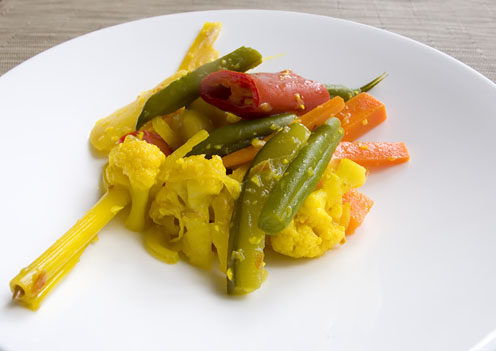
acarkuning2.jpg

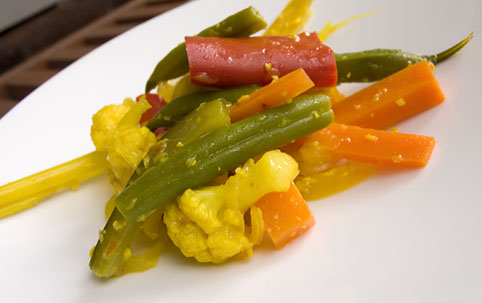
Do not adjust your monitors! This Indonesian vegetable pickle really is that yellow, the result of the addition of the meerest thumb sized piece of pounded fresh turmeric. Turmeric is a rhizome from the ginger family. It’s flesh is bright orange in colour and is sometimes used as a cheap substitute for saffron. One drawback to this fantastic colour is that it also will stain your hands and chopping board while you’re working with it. The way I try to get round it, is by washing my hands and board as quickly as possible after handling it.

Here, the turmeric has been pounded into a paste along with garlic and candlenuts (these waxy nuts which resemble macadamia nuts, act as a sort of thickener). The paste is then fried and forms the base for a great vegetable side dish called Acar Kuning (literally meaning yellow pickle). The Malaysian version of acar is slightly different to the Indonesian one, and is, in my extremely biased opinion, actually slightly better as well. In the interests of trying new things, I thought I would give this recipe a go, and since then have been happily eating these light and crunchy pickles with almost every meal. They are the perfect accompaniment to rich curries or other spicy dishes.

Number 6 on my list from the previous post, was this acar, which I thought I should also share the recipe for. Turmeric-tinted acar is my contribution to this week’s WHB, hosted by Lia of Swirling Notions.

Acar Kuning :
(recipe from South East Asian Food by Rosemary Brissenden)

1 tablespoon vegetable oil
1 brown onion, sliced lengthwise
2-3 red chillies
a few bird’s eye chillies
3 tablespoons white vinegar
1 tablespoon sugar, or less to taste
1.5cm piece fresh ginger, sliced
1 stalk lemongrass, bruised
1 cup water
500g raw vegetables, eg. 150g snakebeans, cut into 4cm lengths; 150g carrots cut into matchsticks; 75g cauliflower florets; 100g cucumber with skin, cut into 4cm strips

Paste Spices :

2cm piece fresh turmeric, chopped (or 1/4 teaspoon turmeric powder)
4 roasted candlenuts (or macadamia nuts), roughly smashed
1-2 cloves garlic, smashed and chopped

Grind the spice paste ingredients into a paste. Heat the oil in a wok and fry the spices and the onion until everything smells fragrant. Add the two kinds of chillies, each sliced into three, the vinegar, sugar, ginger, lemongrass and water. Bring to the boil. Put in the vegetables and stir until the sauce thickens a little and the vegetables are lightly cooked.

Comments (5)

6 reasons to love the place where you come from..

It’s been years; a decade and more, since I’ve returned to Malaysia. The last time I went back, everything looked so much smaller. The front gate of our family home was so fragile and thin looking, even though I’d always thought of it as a metal stronghold to our fortress of a house. The fortress itself, was stunted and stubby, with a modest patch of green for a garden. The driveway which my sister and I used to toboggan down in a rusty folded pram, was so short I wondered how it managed to sustain our downhill excitement at all. During this last trip back, I was constantly encountering mosquitos that prevented me from sleeping at night, and it was so hot and humid that I broke out in a rash and also lost my appetite completely. The good thing was that walking down the street, I actually felt less short, for a change.

I recall, 18 years back, when my parents announced that we were making the move overseas. I was over the moon, having visited Melbourne once before. In my mind, Australia was a land where pinecones and strawberries grew in the backyard, where we could eat apple pie every day for dessert and where seemingly, you could sit in front of the television forever if you wanted to, and always find something to watch (growing up in Malaysia, television only started broadcasting from 4pm onwards).

When we started living in Sydney, I worked hard at trying to fit in. My accent changed (sort of. B still laughs at the way I pronounce certain words). For the first few years, I wanted nothing more than to return to Malaysia on holiday. But gradually, as the letters to and from the Malaysian friends I had been so sorry to leave, decreased from a trickle to nothing, the country itself also became a distant memory and I was soon looking to Europe as my destination of choice.

Looking back now, I realise that I was pretty quick to forget the foods I grew up with. Things I loved then, that I haven’t eaten in a very long while include :

1. Haw flakes
2. Mo Far Kor – also known as tahi hidung, because it looks like nose pickings
3. Durian
4. Kuih Talam
5. Hokkien fried noodles – I think this is what the dish was called. I had it every time my family went for a meal at our local coffee shop. It was nothing more than noodles in a soy sauce, a few green stems and one or two pieces of pork. I think the secret to the dish was the generous use of lard.
6. Lotus seed buns – I prefered these over the red bean paste ones.

Things I embraced in their place :

1. Sara Lee Apple Pie
2. Muesli Bars and Fruit Rollups
3. Lasagne (so exotic, because Garfield loved it)
4. Mudcake
5. Conveyer belt sushi
6. Strawberries dipped in raw sugar

Lately however, I have been thinking about Malaysia and Malaysian food. I’m not sure what spurred it on. Maybe it was Mir’s gift of fried Tempeh all the way from Indonesia, or the Singapore edition of Food Safari, or an aunt’s homemade yam cake at the welcoming party for my sister and her family. It could also have been a very brief conversation that took place at work, when the chef had to organise a themed cocktail party for a Chinese New Year function:

You’re Chinese, aren’t you? He asked.

Yeah, sort of, I replied.

I want you to try my sweet and sour pork later. Let me know what you think.

Ok, but I didn’t really grow up eating stuff like sweet and sour pork.

Really? What did you eat then?

I can’t remember what my reply was, but what I really wanted to say was, it’s funny that people forget how complex the Chinese culture and their food is. When people say do you speak Chinese, they mean Mandarin, and usually when they talk about Chinese food, they mean fried rice, peking duck, salt and pepper squid and sweet and sour pork. Sometimes you forget that one single word encompasses so many other dialects like Cantonese, Hokkien, Hakka, … and their foods are equally as diverse.

Anyway, the conversation got me thinking about the food I grew up with. Usually if anyone ever asks where I’m from, I always say Malaysia, and second from being Australian, I’m also Malaysian Chinese. Apart from Malay food like satay, nasi lemak, beef rendang, roti jala and ketupat, the food I most loved was Nonya (Peranakan food), originally derived from the intermarriages between Chinese immigrants and Malays. My mom has lent me her copy of a definitive Nonya cookbook which I plan to use as often as I can find the time to.

Meanwhile, here are 6 things I have cooked recently, that remind me so much of the place where I came from :

rojak.jpg
1. Rojak

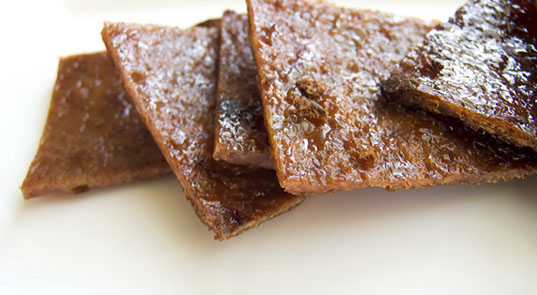
bakkwa.jpg
2. Bak Kwa

sambalikanbilis.jpg
3. Sambal Ikan Bilis

assamfish.jpg
4. Assam Fish

pineappletarts.jpg
5. Pineapple Tarts

acarkuning3.jpg
6. Acar Kuning

More details and recipes, another time..

Comments (11)

« Previous Page · Next Page »