WHB : Coconut and Lavender Macaroons

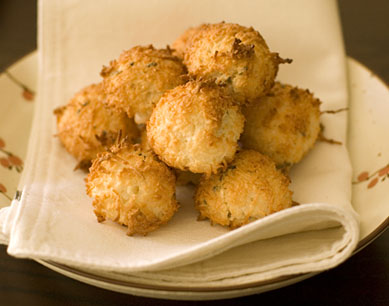
Unlike their more sophisticated French cousins, which are pretty and pastelly, but have no hold over me, I have a weakness for coconut macaroons. I love their rough and tangled look, their crispy golden shells and intense chewy innards.

I recently saw a recipe for coconut macaroons that was quite different to my normal recipe and decided to try it out. Most macaroon recipes are often not worth trying because while they’re incredibly simple and merely require you to fold whipped egg whites and sugar into shredded or dessicated coconut, there’s too much moisture in the mix for the macaroon to stay crisp after it has been baked. What you usually end up with is a disappointing soft macaroon that makes you wonder what the fuss is all about.

This recipe, from a C.I.A. pastry book, is pretty good. It’s not about to replace my favourite recipe, but as far as coconut macaroons go, it yields a rather good product. Good enough that is, for it to take only a few days after baking, for them to disappear completely from our house.

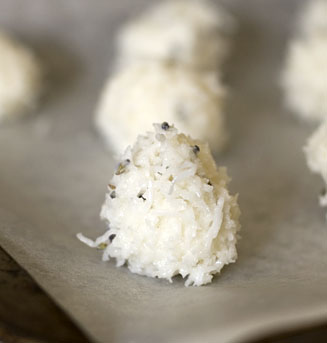
I flavoured my macaroon mix with lavender buds, that beautiful purple flower more commonly associated with potpourri sachets and cupboard air fresheners. Lavender is a member of the mint family and is apparently closely related to herbs such as rosemary and sage. It is said that you can substitute lavender in almost any dish that usually requires rosemary, such as lamb and rabbit, in breads and in desserts such as custards, cakes and ice-creams. The key to remember when cooking with lavender, is that ‘a little goes a long way’, because the inclusion of too much lavender to a dish can render it unpleasantly bitter. Lavender also goes with honey, white chocolate, lemon, goats cheese and, as I have discovered, coconut!

Coconut macaroons, with a hint of lavender, are my contribution to this week’s WHB, hosted by Wandering Chopsticks.

Coconut Macaroons :
(makes about 35 macaroons; recipe from Baking and Pastry, by the Culinary Institute of America)

180g sugar
20g light corn syrup
90g egg whites
272g shredded unsweetened coconut
10g cake flour, sifted

Line trays with baking paper.

Heat the sugar, corn syrup and egg whites over simmering water until the mixture reaches 60’C, whipping constantly. Remove the pan from the heat and mix in the coconut and flour with a wooden spoon until just incorporated. [Here, I also added the lavender buds. 1 teaspoon should be enough, depending on how floral you want your macaroons to be]

Using a No.100 scoop, portion the batter, pressing each scoop lightly, and place in even rows on the prepared trays [I used a measuring tablespoon to do this]. Air-dry until slightly dry, about 1 hour.

Bake at 191’C until the cookies are a light golden brown, about 12 minutes. Cool completely on the tray.

Comments (13)

Click Yellow for Bri

I bought a big bag of lemons the other day, because I love a bargain, and lemons are always useful in the sweet or savoury kitchen. Not long after making a batch of yellow macarons, I came across Kalyn’s post about a special fundraiser, and decided that I had to particpate immediately.

This lemon macaron, filled with lemon iced mousse is dedicated to a special edition of Click! for this month. For June 2008, Click Yellow for Bri is aimed at raising funds to help Brianna’s battle against cancer. You can read more about the fundraiser here, and make a contribution as well, if you’re able to.

Lemon Iced Mousse :
(from Essence by David Everitt-Matthias)

juice of 6 lemons
grated zest of 3 lemons
200ml double cream
100g caster sugar
30ml water
4-5 egg yolks (approximately 120g)

Put the lemon juice and zest in a smal lpan and boil until reduced to 75ml. Remove from the heat and set aside. Whip the double cream until it forms soft peaks and then set aside in the fridge.

Place the caster sugar and water in a small saucepan and heat gently, stirring, until the sugar has dissolved. Bring to the boil and boil until it reaches the soft-ball stage (115’C on a sugar thermometer). While it is boiling, whisk the egg yolks in a freestanding electric mixer until thick, airy and very pale. When the sugar syrup is ready, slowly drizzle it on to the egg yolks with the machine running on high. Continue to whisk until cold.

Fold in the lemon juice, then the whipped cream. Freeze the mixture until set; this will take at least 6 hours.

Comments (5)

Honeyed lips : Baklava

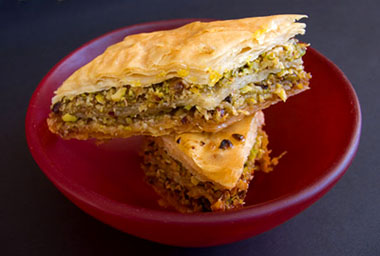
The second edition of A.W.E.D., kickstarted by Dhivya of Culinary Bazaar, features Middle Eastern Cuisine. For it, I have made Baklava, that sticky and aromatic sweet featuring an abundance of nuts and honey between layers of fine pastry. It is widely regarded as one of the most well known and popular of Middle Eastern sweets, and I am quite happy to be a fan of it, regardless of it’s exact provenance.

I know quite a few people who would screw their face up at the idea of eating baklava. Too sweet, and too rich, are their usual objections. But if you try making it or if you have bought it from a reputable source, you’d be surprised at how different and elegant it can be. If you don’t mind me saying so, there’s even something incredibly sexy and seductive about baklava. I’ve seen perfumed syrup poured over hot trays of baked baklava; the resulting steam rising between the pieces of baklava causing them to ‘dance’. If these baklava had bellies, I could imagine them shimmying, draped in sparkling pistachio-coloured jewels; smiling, through honeyed lips.

This recipe comes from Belinda Jeffery, who credits it to her mom who loved cooking dishes from all around the world.

Pistachio and Walnut Baklava :
(from Mix & Bake by Belinda Jeffery)

200-250g unsalted butter
500g filo pastry
250g pistachios, finely chopped
250g roasted walnuts or pecans, finely chopped
110g castor sugar
1 teaspoon ground cinnamon
1/4 teaspoon ground nutmet
40 whole cloves (optional)

Honey Syrup :
330g castor sugar
250ml water
120g clear honey
1/2 cinnamon stick
finely chopped zest 1 lemon
2 tablespoons lemon juice
finely chopped pistachios (optional), for sprinkling

Gently melt the butter in a small saucepan over very low heat, then leave it to cool. Once it’s cool, use a spoon to skim off any white scum that floats on top, then carefully pour the clear golden liquid that remains into a jug.

Brush a 32 x 24 x 5cm baking tin with some of the butter. Cut the filo sheets in half widthways and trim them so they’re a similar size to the tin. Cover them with a damp tea towel to keep them pliable and stop them drying out.

In a bowl, thoroughly mix together the nuts, sugar, cinnamon and nutmeg. Line the base of the prepared tin with a third of the filo sheets, brushing each sheet very lightly with the melted butter as you go. You may have to slightly overlap the sheets if they don’t quite fit the tin, and make sure you press them into the corners and sides too. Sprinkle half the nut mixture evenly over the filo and shake the tin gently to even it out. Repeat the layering with another third of the filo and butter, then top with the remaining nut mixture. Layer the remaining filo over this, brushing it with butter as you go, then brush the top with butter too. If necessary, trim and discard any excess filo from around the sides of the tin with a sharp knife.

Put the tin in the fridge for about 20 minutes to firm up the baklava so it’s easier to score. When it’s firm, use a fine sharp knife to score the baklava, right through to the base, into diamonds of whatever size you want. Push a clove, if using, into the centre of each one.

Preheat your oven to 180’C. Bake for about 1 hour or until the top of the baklava is deep golden brown. Check it occasionally and cover it loosely with foil if it seems to be browning too quickly.

Meanwhile, for the syrup, combine the sugar, water, honey and cinnamon stick in a saucepan over high heat. Stir the mixture until the sugar dissolves, then stop stirring and bring it to the boil. Reduce the heat to very low and simmer the syrup, uncovered, for 20 minutes, skimming off any white foam that floats on the surface. Remove the syrup from the heat, discard the cinnamon stick and stir in the lemon zest and juice. Keep the syrup in a warm spot.

When the baklava is ready, remove it from the oven. Cool it on the wire rack for 1 minute, then slowly drizzle the warm syrup evenly over the top. Leave it to cool completely – the flavour is best if the baklava mellows for 12 hours or so before serving.

To serve the baklava, cut down through the score marks to loosen the diamonds, then ease them out. You can leave the cloves in (but remember to take them out before eating a piece because the cloves pack a powerful punch), or pull them out and sprinkle the tops with chopped pistachios, if liked.

Comments (10)

« Previous Page · Next Page »