Fig Bars

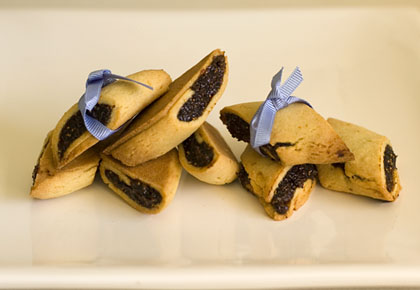
If you read the previous post about smelly prawn smells, rest assured, you can breathe deeply now because I have managed to neutralise the odour somewhat by baking a batch of figgy pastries. They are called Fig Bars, but I actually prefer to rename them Fruit Pillows because they remind me of a biscuit I used to eat all the time.

I loved Arnotts Fruit Pillows as a kid. It was one of those things I could never have just one piece of. The main reason was nothing more complex than the fact that I loved the name. Fruit Pillows conjured up images of beds constructed entirely of biscuits with soft marshmallow quilts and pastry pillows. It was with this in mind that I got really excited when I saw Sherry Yard’s recipe for Fig Bars, which look just like Fruit Pillows : cookies consisting of a fruity-jammy interior, enveloped by a short biscuit layer.

This recipe is a cinch and a very rewarding one. The pastry is crisp and not too sweet, allowing the flavour of the figs to really stand out. I veered from the recipe slightly by using an apple and blackcurrant juice instead of straight apple juice. Also, if you want to, you can even reduce the amount of sugar in the fig mixture to make it an even healthier snack – one you might find yourself making again and again, with varying flavours (other dried fruit like raisins and cranberries or even dates, might be nice). That is, as long as you don’t make silly mistakes like going off to watch tv during the final stages of the fig-simmering process, thus allowing it to scorch the bottom of the pan, forcing you to start all over again! No prizes for guessing who that happened to!

Fig Bars are my contribution to Sarah’s Tastes to Remember event.

Fig Bars :
(from Desserts by the Yard, by Sherry Yard)

For the fig filling:

1 cup finely chopped dried Black Mission figs
1 1/2 cups water
1 cup apple juice
1/4 cup sugar
1/8 teaspoon grated orange zest

For the cookie dough:

113g unsalted butter, softened
1/2 cup vanilla sugar
1/2 teaspoon grated orange zest
1 large egg white
1/2 teaspoon vanilla extract
1 1/2 cups plain flour

Make the filling: Combine the chopped figs, water, apple juice, and sugar in a medium saucepan and bring to a boil. Reduce the heat to low and cook at a bare simmer for 1 to 2 hours, until the figs are so soft that they’re spreadable.

Transfer to a food processor fitted with the steel blade, add the orange zest and process until smooth. Remove from the food processor and allow to cool.

Make the dough: Cream together the butter, vanilla sugar, and orange zest in the bowl of a stand mixer fitted with the paddle attachment, for 2 to 3 minutes on medium speed. Scrape down the bowl and paddle. Add the egg white and vanilla and beat in. Scrape down the sides of the bowl and the paddle. Add the flour and beat on low speed until the dough comes together. Wrap in plastic wrap and refrigerate for 2 hours.

Place racks in the middle and lower third of the oven and preheat the oven to 176’C. Line trays with baking paper.

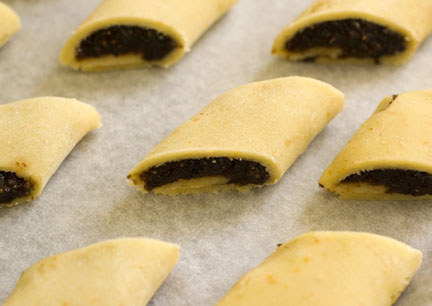
On a floured surface, roll the dough out to a 12 x 16 inch rectangle. Cut into 4 equal strips, each 12 x 4 inches. Spoon a line of filling down the center of each strip. Fold the dough over the filling and pinch the edges together. Place on the lined baking trays, seam side down. (At this point the fig bars can be frozen for up to 2 weeks, wrapped airtight).

Using a serrated knife, slice each log ont the diagonal into ten cookies. Bake, rotating the baking trays from top to bottom and from front to back halfway through, for 12 to 15 minutes, until golden. Remove from the oven and allow to cool on a rack. (The bars will keep, stored airtight, for 2 days).
Comments (9)

Traces of Balachaung

Signs you’re in an Asian house #45 :

We were over at Jaime’s place a couple of weeks ago and before leaving, Jaime invited us to take some cake and iced buns home. After not much feeble protesting, we acquiesced and she proceeded to pull out some plastic take-away containers from her cupboard. That was when I noticed exactly how many take-away containers she owned.

You know it’s an Asian house if there’s tons of take-away containers in the cupboard, Jaime said, with a grin. Not that I ever thought about it before, but now that I have, I too have a collection (though a more humble sized one). At home, my mom has a mountain of plastic containers. Probably enough to supply a Chinese restaurant. It’s for leftovers (no one ever ever throws out leftovers) and all those occasions when you have people over and insist on pressing food into their hands as they walk out the door. I’d like to think that these plastic containers stay within the circle of food-givers, getting recycled over and over again as vessels for kuih, fried rice and frozen curry puffs, so hopefully, it’s not all that bad for the environment!

Signs that you’re in an Asian house #46 :

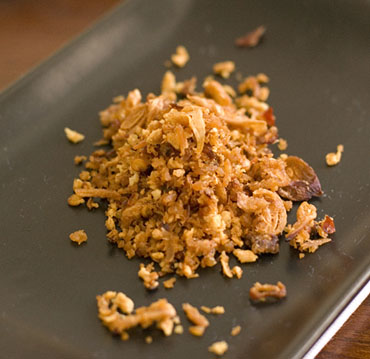
That day, Jaime also introduced me to a fantastic Burmese condiment called Balachaung. It’s a concoction of dried shrimp, fried garlic and shallot, flavoured with shrimp paste and is extremely good sprinkled on anything. I tried making it today, and as soon as the shrimp paste started toasting and the dried prawns hit the oil in the pan, that characteristic smelly prawn smell I get virtually every time I cook something Malaysian, enveloped the entire kitchen. This smell, is going to take a week to rid the apartment of!, I thought with a big sigh. Don’t get me wrong, I love shrimp paste but only when I’m eating, not as a room fragrance.

Signs you’re in an Asian house #47 :

You’re visiting a friend’s place and the conversation lurches from iced buns to Balachaung in the one breath.

Sambal Balachaung :
(makes 2 cups; from Green Mangoes and Lemongrass by Wendy Hutton)

125 ml vegetable oil
3 tablespoon sesame oil
10 shallots, sliced
10 cloves garlic, thinly sliced
125g dried prawns
60ml (1/4 cup) rice or white vinegar
1 – 3 teaspoons crushed dried chilli flakes
1 teaspoon salt
1/2 teaspoon toasted dried shrimp paste

Heat both lots of oil in a wok. Add the sliced shallots and cook over low heat, stirring frequently, until they are golden brown and crisp. Lift out with a slotted spoon and drain on paper towel, leaving the oil in the wok. Add the sliced garlic and cook as for the shallots, making sure it does not turn dark brown. Drain and set aside.

Do not soak the prawns but put them into a food processor and process to a powder. Reheat the oil left in the wok and add the prawn powder. Stir fry over low heat for 5 minutes, then add the vinegar, chilli flakes, salt and shrimp paste. Cook, stirring frequently, for 5 minutes. Remove from the wok and spread on a couple of layers of paper towel to absorb the oil. When completely cold, put the prawn mixture in a bowl and toss with the fried shallots and garlic. Transfer to a tightly sealed jar.

[Note: If you’re feeling lazy, you can use bought fried shallots and garlic. Just proceed with the prawn part of the recipe, and after the prawn mix has cooled down, add 1/2 cup fried shallots and less that amount, of fried garlic. Delicious!]

Comments (7)

WHB : Pepper Chicken Chettinad

This week’s WHB is hosted by Anh of Food Lover’s Journey and my featured ingredient is pepper.

Dried black peppercorns (melagu), which are a fruit and are native to South India, are the star component of this South Indian dish called Pepper Chicken Chettinad (Koli melagu varuval). The peppercorns are toasted and ground up and add a robust warmth and comforting heat to a very simple chicken dish which I think is a perfect weekend meal. It only requires a satisfyingly small number of ingredients, and the end result is so flavoursome it’s hard to believe so little work went into it’s being.

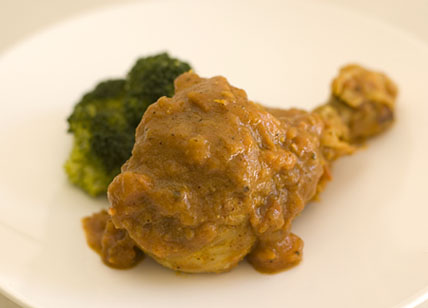
This recipe appears in the new book Qmin by Anil Ashokan and was featured in a recent edition of Gourmet Traveller. Recommended accompaniments to this dish include lemon rice and stir fried green beans. In a fit of “my body is my temple” pique, I served this with gloriously nutty brown rice and steamed broccoli.

Pepper Chicken Chettinad :
(Koli melagu varuval)

4 chicken breasts on the bone, skin on
1/2 tsp ground turmeric
8 golden shallots
12 cloves of garlic
1 tsp fennel seeds
6 dried red chillies
1 tbsp black peppercorns
5 tomatoes
125ml vegetable oil

1 Clean and trim the chicken breasts. Season to taste with sea salt and sprinkle with turmeric and set aside.

Peel the shallots and garlic. Dry-roast half the fennel seeds with chillies and peppercorns over gentle heat, stirring constantly. Crush using a pestle and mortar. Crush the shallots and garlic in a blender, then mix in the pounded spices. Chop up the tomatoes roughly.

Heat oil in a heavy-based saucepan over high heat. Put in the rest of the fennel seeds and then the chicken breasts. Seal well on all sides and remove. Add the tomato and some salt. Stir and cook well. Add the garlic, shallot and spice mix and cook over medium heat, stirring constantly. Return chicken to the pan and simmer over low heat until it reduces to a thick sauce consistency.

[Note: I used chicken drumsticks and finished the cooking process in the oven at a low temperature so that the meat on the drumsticks would be very tender]

Comments (4)

« Previous Page · Next Page »